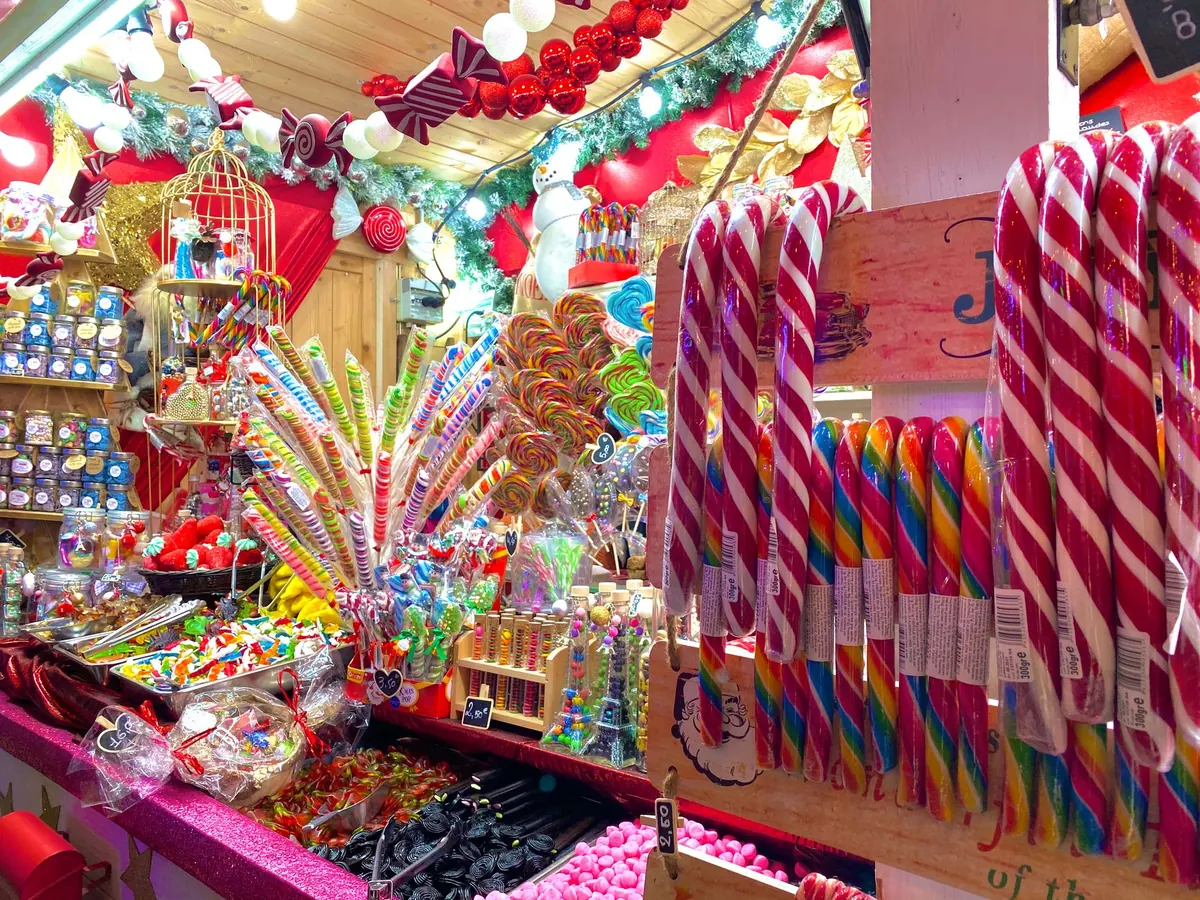
Every seaside town smells of three things: chips, sun cream and boiling sugar. Between the arcade and the harbour wall there is usually a sweet shop, either a narrow one with jars stacked to the ceiling or a bright frontage loaded with metre-long sticks of rock. What's on the shelves changes as you move round the coast, and a little local knowledge turns a paper bag of sugar into the best souvenir of the day.
Follow the coastline for a fortnight and you can eat your way across a genuinely regional cuisine. Aniseed rules the north-east, clotted cream fudge holds the south-west, tablet belongs to Scotland and cinder toffee is a northern speciality that has never quite crossed the border in the same form. None of it is fancy. All of it is made to be eaten outdoors, in wind, with sandy hands, and it tastes better for it.
What to look for in a coastal sweet shop
There are two kinds. One buys everything in, tips it into trays and sells it by the quarter. The other makes its own out the back, and you can normally tell before you get through the door: warm air, a faint smell of caramel, a marble slab, fudge cut from blocks rather than arranged in neat factory squares.
Freshness matters more here than in most confectionery, because so much of it is sold loose and made in small batches. Fudge, tablet, honeycomb and toffee all lose their best texture within days. Rock is the exception. Made properly and kept dry, it will outlast your holiday by months.
Watch the counter, too. A good shop will have a slate or a card naming who made what, and dates on the trays. If everything is the same uniform shade of beige and the assistant has to check a laminated list to tell you what's in it, you are in the first kind of shop. Buy a stick of rock and move on.
Rock: sugar with the town's name running through it
A stick of rock is a genuinely clever piece of confectionery. Boiled sugar is flavoured, usually with peppermint, then split into portions and coloured. Some of it is rolled into thin strips that become letters. Those letters are built up into a word, wrapped in more sugar, and the whole thing is drawn out thinner and thinner until the name runs the entire length of the stick. Break a real one anywhere and you can still read it.
It is, when you think about it, a postcard you can eat — and the only one that survives the journey home.
How to pick a good stick
- Break it in the shop if you're allowed. The letters should be crisp and readable all the way through, not blurred or half-missing.
- Look at the ends. Neat, tightly packed sugar with no gaps — air bubbles mean it was drawn too fast.
- Snap, don't bend. A fresh stick cracks cleanly.
- Colour should be bright rather than bleached. Sticks that have sat in a sunny window for months look pale and taste flat.
- Check the wrapper. Buy one that's still sealed; loose rock in a warm shop goes tacky and picks up every smell in the place.
- Ask for rock ends if you're only feeding children on the way home. They're the offcuts, identical in taste, and usually sold cheap by the bag.
Peppermint is the classic, but you'll find fruit, aniseed, clove and various gin-and-tonic imitations, plus lemon in the north-east and a hard, sharp raspberry that seems to exist only in Yorkshire. Blackpool and Brighton both claim the lettered rock tradition, and both will sell you a stick with the town's name running through it, which is the whole point. A stick that says nothing is just boiled sugar.
Fudge, tablet and the rest of the counter
Fudge is the other great seaside purchase and the one most often ruined. Properly made, it is sugar, butter, milk or cream and flavour, boiled to soft ball, poured onto a slab, then worked with a paddle or a scraper until it grains and sets. That working is what gives it the short, melting crumble rather than a chewy, gluey pull. It should soften under your thumb, smell of butter and vanilla, and never taste greasy.
How to tell good fudge from bad
- Texture: smooth and slightly grainy, not waxy. Waxiness usually means vegetable fat and glucose syrup instead of butter.
- Scent: it should smell of dairy and flavour, not just sugar.
- Cut: blocks cut by hand have uneven edges and a faint sheen. Perfect cubes from a machine often mean a long shelf life and a rubbery chew.
- Flavour: vanilla, clotted cream, rum and raisin and salted caramel are the safe bets. Anything neon is for the photographs, not the eating.
Then come the relatives. Tablet is the Scottish cousin: boiled harder, poured thin, and deliberately grained so it crumbles and squeaks against the teeth. It keeps far better than fudge and travels well. Cinder toffee, or honeycomb, is sugar and golden syrup hit with bicarbonate of soda so it foams and sets into a brittle, airy slab, often half-dipped in chocolate. It is magnificent for about four days and then it starts to weep and go sticky, so eat it fast and keep it in a tin. Toffee proper, the dark, buttery, tooth-threatening sort, is the one to buy if you have strong fillings and a long drive home.
Local specialities worth the detour
Half the pleasure of coastal sweets is that they are stubbornly local. If you are travelling, these are the ones worth planning a stop around:
- Cornwall and Devon: clotted cream fudge, sold in thick slabs and best eaten the same day. Also look for vanilla fudge dusted with icing sugar rather than wrapped in plastic.
- Scotland: tablet, macaroon bars, soor plooms and hard, sharp aniseed balls sold loose from jars. The west coast towns do this better than anywhere.
- The north-east: cinder toffee, lemon rock and peppermint humbugs, often still sold by the quarter from a brass scale.
- Blackpool: lettered rock in every flavour imaginable, plus the traditional aniseed and clove versions that most other places have dropped.
- Brighton: the original seaside rock, cut in short sticks and sold in striped paper bags along the front.
- Wales: Llandudno and the north coast for rock and fudge, with a strong line in coconut ice.
- The Lakes, if you're stretching the definition: Kendal mint cake and Grasmere gingerbread, both of which have been sold to walkers for well over a century.
Ask the person behind the counter what they make themselves. It is almost always the shortest route to the best thing in the shop, and they will usually tell you which tray came in this morning.
Getting your haul home in one piece
Sugar is fragile in heat and dull in humidity, and a car boot in August is neither. A few small habits will get everything back intact:
- Buy fudge, tablet and honeycomb on the last day, not the first. Rock can wait; the rest cannot.
- Keep rock sealed and out of the sun. Wrapped and cool, it will still be good at Christmas, and the lettering will still read.
- Layer honeycomb between sheets of greaseproof in an airtight tin. Left loose in a bag it welds itself into one sticky brick.
- Refrigerate fudge only if you must, and bring it back to room temperature before eating. Cold fudge tastes of nothing.
- If you're flying, pack rock in hand luggage and fudge in the middle of soft clothes. Both survive; neither enjoys a hold at altitude.
Buy one thing to eat on the promenade and one thing to take home. That way the holiday lasts exactly as long as the sugar does, which, with a well-chosen stick of rock, is a good deal longer than the tan.
Photo: Tatiana Sukhova / Pexels